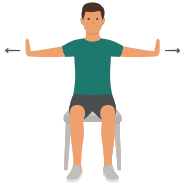
Chest
Doorway stretch
Stand in a doorway, forearm on the frame with your elbow at shoulder height, and step forward until you feel the front of your chest open. Hold 30 seconds per side.
30 secondsYou catch your reflection in a shop window and there it is: shoulders rolled forward, upper back curved like a question mark. You search for hunchback exercises because sitting up straight only lasts until the next email. This guide gives you the stretches and strength work that go after the cause instead of the reminder.
The plan has 2 halves and they only work together. Stretches give the front of your body its length back, so your shoulders are physically able to sit further back. Exercises wake up the muscles between your shoulder blades, so they hold that position without you thinking about it.
Everything below fits into normal days. There is a version with no equipment, a version for the gym, and a slow version if yoga is more your thing.
You spend most of the day with your arms in front of you. Typing, driving, scrolling, cooking. In that position the muscles across your chest spend hours shortened, and the muscles between your shoulder blades spend hours stretched and quiet. Over time the short side gets tight, the quiet side gets weak, and your shoulders settle forward because that is now the path of least resistance.
That is why "sit up straight" never lasts. You are asking willpower to hold a position your tissues no longer support. The way out is not more willpower. It is changing what the tissues can do, with length in the front and strength in the back.
A rounded upper back is a habit your body has rehearsed for thousands of hours. It responds to small daily doses, not to 1 heroic session.
These are what people search for as anti hunchback stretches or upper back pain stretches. Each one does 1 of 2 jobs: it opens the front of your chest, or it gets your mid back moving again after hours of holding the same shape.
Chest
Stand in a doorway, forearm on the frame with your elbow at shoulder height, and step forward until you feel the front of your chest open. Hold 30 seconds per side.
30 seconds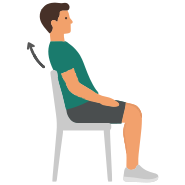
Upper back
Sit tall, hands behind your head, and lean back so your upper back arches over the top edge of the chair. 5 slow leans, exhaling as you go back.
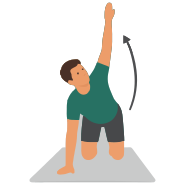
The drawing shows the basic version of the move.
Upper back
On all fours, slide 1 arm under your body until that shoulder rests near the floor. You should feel it right between the shoulder blades. Hold 20 seconds per side.
20 secondsFrom all fours, walk your hands forward and let your chest sink toward the floor while your hips stay over your knees. Hold 30 seconds and breathe.
30 secondsA stretch should feel like tension easing, never like pain. If anything sharpens or tingles, back off.
Stretches open the door. Strength is what keeps it open. This routine takes about 10 minutes and needs nothing but a bit of floor and a wall.
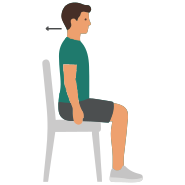
Neck
Sitting or standing, glide your head straight back, as if making a double chin, without tilting up or down. Hold 5 seconds. 10 reps.
10 reps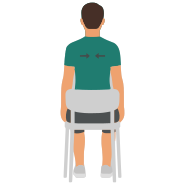
Upper back
Pull your shoulder blades down and toward each other, as if holding a pencil between them. Hold 5 seconds. 10 reps.
10 reps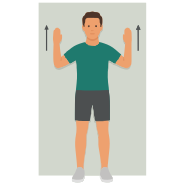
Upper back
Back against a wall, arms in a goalpost shape, slide them up and down while keeping wrists and elbows as close to the wall as you can. 8 slow reps.
Lie face down, arms overhead in a Y, thumbs pointing up. Lift your arms a few centimetres off the floor, hold 3 seconds, lower. 10 reps.
10 repsDo 2 or 3 rounds. The weight of your own arms is enough at the start. The goal is teaching these muscles to switch on again, not exhausting them.
If you already train, the simplest rule for rounded shoulders is to pull more than you push for a while. Rows and pulls load exactly the muscles that hold your shoulder blades back, and routines built around pressing tend to leave them behind.
Go lighter than your ego wants. A rep only counts if you feel the squeeze between your shoulder blades at the end of it.
Searches for upper back pain yoga and rounded shoulders yoga usually want the same thing: slow movement that opens the chest and gets the spine extending instead of flexing all day. These poses do that without needing a class.
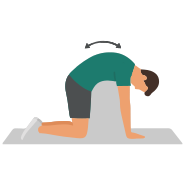
Upper back
On all fours, alternate between rounding and arching your spine, moving with your breath. 10 slow cycles.
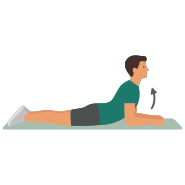
Lower back
Lie face down, prop yourself on your forearms and let your chest lift while your hips stay heavy on the floor. Hold 30 seconds.
30 secondsWrap 1 arm under the other, palms together if you can, and lift the elbows. You will feel it right between the shoulder blades. 20 seconds per side.
20 secondsLie on your back with a rolled towel running along your spine, arms out wide, and just breathe for 1 or 2 minutes.
2 minutesYoga works here for the same reason the stretches do: length in the front, movement in the middle. The breathing just makes you slow down enough to do it well.
When this is not for you and it is time to see a healthcare professional. These exercises are for the everyday stiffness of a desk-shaped life, not for everything. See a healthcare professional if the pain wakes you at night or keeps you from sleeping, if it runs down an arm, if you notice tingling or loss of strength in your hands, if it started after a blow or a fall, or if you have done gentle work like this for a few weeks and nothing has changed.
You do not need all of this. You need a small dose you will actually repeat.
5 minutes a day beats 45 minutes on Sunday, because you are competing with the hours your body spends rehearsing the hunch. Attach the dose to something you already do and it stops needing willpower at all.
BackPain gives you 5 minutes of gentle exercises a day, chosen by where it bothers you and what you are after. At home, no equipment, guided one at a time. If there are exercises you like more, build your own routines with them: the best exercise is the one you will actually do.


7-day free trial · Cancel anytime
It depends on what kind of curve it is. If your upper back rounds out of habit and softens when you lie flat on the floor, stretches and strength work can change how you carry yourself day to day. If the curve stays rigid no matter what position you are in, that is a question for a healthcare professional, not an exercise list.
There is no honest number, because it depends on how many hours a day your body rehearses the opposite. The stretches usually ease tightness within days, while carrying your shoulders differently by default takes weeks of small daily doses. Consistency matters far more than intensity.
The doorway stretch, because it goes after the shortened chest muscles that pull your shoulders forward in the first place. Pair it with thread the needle: 1 opens the front, the other gets the middle moving. Hold each for 20 to 30 seconds and repeat through the day.
Yes, in small doses. 5 to 10 minutes daily works better than 1 long session a week, because you are competing with all the hours you spend sitting. If a muscle feels sore, keep the stretches and skip the strength work for a day.
It can be, because many poses extend the spine and open the chest, which is exactly what a rounded upper back needs more of. Cat-cow, sphinx and eagle arms are the most direct ones. You do not need a full class, a few slow minutes count.
BackPain is a wellness app, not a medical device. This guide is general information and is no substitute for a healthcare professional. It does not diagnose, treat, cure or prevent any condition. If your pain persists, see a healthcare professional.