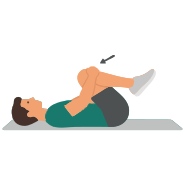
Lower back
Knees to chest
- Lie on your back and pull 1 knee gently toward your chest with both hands.
- Hold for 5 slow breaths, then swap legs.
- Finish by hugging both knees at once for another 5 breaths.
It is late afternoon, your lower back feels stiff from sitting, and you have typed lower back pain yoga into your phone more than once. You do not need a class, a mat full of poses or a gym membership. A few gentle moves, done most days at home, is what tends to make the biggest difference.
Stretches, yoga, workout: when it comes to the lower back, those 3 words mostly point at the same thing. Gentle movement, repeated often, in a range that feels fine.
This guide gives you moves you can do in bed before getting up, a short yoga-style routine for the floor, a small strength circuit with no equipment, and a note on what to do at the gym while your back is cranky. Pick what fits your day. The habit matters more than the label.
None of these moves is complicated. What decides whether they help is how you do them, and how often.
If a move makes the discomfort sharper, or sends it somewhere it was not before, skip that move today. There are plenty of others on this page.
Mornings are often the stiffest part of the day, and the good news is you do not need to get up first. These 3 work fine on a mattress. A firmer surface gives you a little more feedback, but the bed version still counts.
Lower back
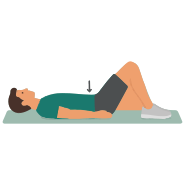
Lower back
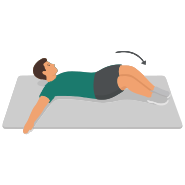
Lower back
Search for lower back pain stretches yoga and you get hour-long classes. You do not need the class. A handful of shapes do most of the useful work for the lower back, and they take 5 minutes on a mat or a folded towel.
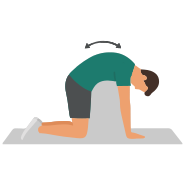
Upper back
On hands and knees, round your back up as you exhale, let it sink as you inhale. 10 slow rounds. This is the single best way to get a stiff lower back moving.
From hands and knees, sit back toward your heels with arms stretched forward. Let your back lengthen for 5 to 10 breaths.
5 to 10 breaths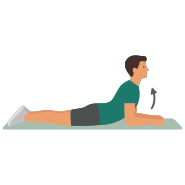
Lower back
Lie on your front, prop yourself on your forearms, and let your lower back settle into a gentle arch. 5 breaths. If it feels pinchy, drop lower or skip it.
5 breaths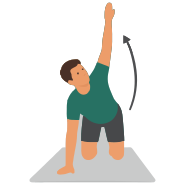
The drawing shows the basic version of the move.
Upper back
From hands and knees, slide 1 arm under your chest and rest your shoulder down. It reaches the mid back, which often drags the lower back into stiffness with it.
Nobody is checking your form against a video. If a shape feels good and you can breathe in it, it is doing its job.
Stretching eases stiffness in the moment. A bit of strength around the hips and trunk helps your back cope with everything the day throws at it. This circuit needs no equipment and fits in a hallway.
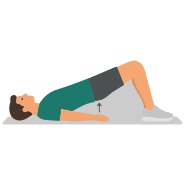
Lower back
On your back, knees bent, push through your heels and lift your hips until your body is a straight line from knees to shoulders. Lower slowly. 10 reps.
10 reps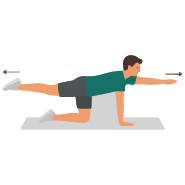
Lower back
On hands and knees, reach 1 arm forward and the opposite leg back without letting your hips tip. Hold for a breath, swap sides. 8 per side.
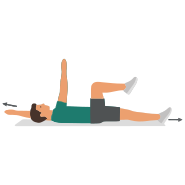
Lower back
On your back, arms up, knees over hips. Lower 1 arm and the opposite leg toward the floor while your lower back stays quiet. 8 per side.
1 round takes about 3 minutes. Do a round or 2, and let slow and controlled win over fast and many. If a rep makes your back grumble, shrink the movement until it does not.
A grumpy lower back is not a reason to cancel the gym. It is a reason to edit the session. Moving usually feels better than a week on the sofa, as long as you respect what the back is telling you.
The test is simple. If your back feels the same or better the morning after, the session was fine. If it feels clearly worse, you did too much, so take the next one down a notch.
When this is not for you and it is time to see a healthcare professional. These moves are for everyday stiffness and mild discomfort. See a healthcare professional instead if the pain runs down a leg, if you feel tingling or numbness, if a leg feels weaker than usual, if the pain started after a blow or a fall, if it keeps you from sleeping, or if weeks of gentle movement have changed nothing.
You do not need all of this. You need 3 moves you will actually repeat.
If your back has a better week, keep going anyway. Gentle daily movement is a floor you stand on, not a course you finish.
BackPain gives you 5 minutes of gentle exercises a day, chosen by where it bothers you and what you are after. At home, no equipment, guided one at a time. If there are exercises you like more, build your own routines with them: the best exercise is the one you will actually do.


7-day free trial · Cancel anytime
The gentle shapes are, for many people. Cat-cow, child's pose and a lying twist get a stiff lower back moving without asking much of it. You do not need a full class or any flexibility to start. 5 minutes of the moves in this guide covers the useful core of it.
The best stretches are the ones you repeat most days. Knees to chest, the lying twist, cat-cow and child's pose are a solid set. Hold each for about 5 slow breaths and stay in a range that feels like a stretch, not a strain.
Yes. Knees to chest, pelvic tilts and the lying twist all work on a mattress, and doing them before you get up is a good way to start a stiff morning. A firmer surface gives slightly more feedback, but the bed version still counts, and done beats perfect.
No, the moves are the same for everyone. What men often bring is tighter hips and hamstrings, so holds like child's pose and knees to chest may feel harder at first. That is a reason to go slower and breathe longer, not to pick different exercises.
Usually yes, with edits. Keep walking, cycling and light upper body work, lighten squats and deadlifts, and park heavy lifts off the floor for now. If your back feels the same or better the next morning, the session was the right size. If the pain is sharp, runs down a leg or comes with tingling or weakness, stop and see a healthcare professional.
BackPain is a wellness app, not a medical device. This guide is general information and is no substitute for a healthcare professional. It does not diagnose, treat, cure or prevent any condition. If your pain persists, see a healthcare professional.