Lower back
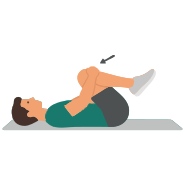
Knee to chest
On your back, pull 1 knee toward your chest with both hands, the other leg bent or straight. Hold 20 to 30 seconds, swap sides, then hug both knees together for another 20.
20 to 30 secondsThe alarm goes off, you sit up, and your lower back feels like it set overnight. The first trip to the bathroom is more shuffle than walk. A few minutes of morning back stretches can take the edge off that stiffness before your coffee does anything.
Waking up stiff is one of the most common back complaints there is, and in most cases it is not a sign that anything broke while you slept. It is what a back does after hours of lying still.
This guide gives you the moves. Morning lower back stretches you can start in bed, upper back stretches for the patch between your shoulder blades, standing versions for small spaces, and a 5-minute routine that strings them together.
You have been more or less still for 7 or 8 hours. Muscles cool down and tighten a little, and the discs between your vertebrae soak up fluid while you lie down, which leaves your spine slightly taller and noticeably stiffer first thing. That stiffness is not damage. For most people it fades within the first hour, and faster if you move.
It also has very little to do with how straight you stand during the day. Some people slouch for years and never hurt, others stand tall and still wake up stiff. What reliably helps a stiff back is regular, gentle movement, and the morning is a good slot for it because the stiffness is right there asking.
Stiffness that eases as you move is normal. Stiffness that gets worse over weeks, or pain that wakes you at night, is a different story. See the note at the end of this guide.
For timing, hold each stretch 20 to 30 seconds, or rock gently through the movement 8 to 10 times. Both work. Pick whichever feels better in your body today.
These 4 are done lying down, so you can do the first few before your feet touch the floor. If your mattress is soft, the floor gives firmer support and the stretches feel cleaner there.
Lower back
On your back, pull 1 knee toward your chest with both hands, the other leg bent or straight. Hold 20 to 30 seconds, swap sides, then hug both knees together for another 20.
20 to 30 seconds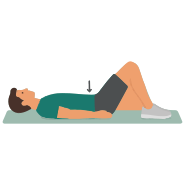
Lower back
Knees bent, feet flat. Gently flatten your lower back into the surface, then let it arch a little. Small and slow, 10 times.
10 timesKnees bent and together, let them fall slowly to 1 side as far as comfortable, come back to centre, then the other side. 8 to 10 each way.
Once you are on the floor, sit back toward your heels, arms stretched forward, forehead down. Breathe there for 20 to 30 seconds.
20 to 30 secondsIf any of these makes the stiffness spread or sharpen, stop. Loosening should feel like relief, not a fight.
The upper back stiffens for a slightly different reason. It barely moves at night, and then it spends the day aimed at a screen. These 3 moves wake it up, and they are the part most people skip.
Upper back
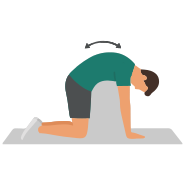
On hands and knees, round your back toward the ceiling, then let it dip while your chest lifts. Slow, 8 to 10 rounds, following your breath.
8 to 10 rounds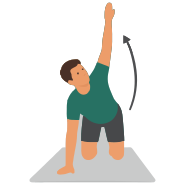
The drawing shows the basic version of the move.
Upper back
From hands and knees, slide 1 arm under your chest, palm up, until that shoulder sinks toward the floor. Hold 20 seconds, swap sides.
20 seconds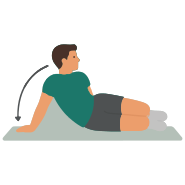
Upper back
Lie on your side, knees bent, arms stacked in front of you. Lift the top arm and sweep it open behind you, letting your eyes follow the hand. 8 slow reps, then the other side.
Travelling, in a hurry, or just not keen on getting down on the floor? These standing versions cover the same ground. They fit in the time a kettle takes to boil.
Here is how it strings together when you give each piece about 1 minute. You can trade any move for another from the same section.
That is the whole thing. No equipment, no outfit change, done before the coffee is ready.
Consistency beats intensity. 5 gentle minutes every morning does more for a stiff back than 1 long session on Sunday.
When this is not for you and it is time to see a healthcare professional. These stretches are for ordinary morning stiffness that eases as you move. They are not for everything. See a healthcare professional if your pain runs down a leg or an arm, if you notice tingling or loss of strength, if pain keeps you from sleeping or wakes you at night, if it started after a blow or a fall, or if weeks go by without any change.
You do not need all 11 moves. You need a handful you will actually do, at a time your body is asking for them.
BackPain gives you 5 minutes of gentle exercises a day, chosen by where it bothers you and what you are after. At home, no equipment, guided one at a time. If there are exercises you like more, build your own routines with them: the best exercise is the one you will actually do.


7-day free trial · Cancel anytime
For most people, yes, as long as it stays gentle. Your back is at its stiffest right after waking, so start with small ranges and build through the reps. If a particular stretch sharpens the pain instead of easing it, skip that one.
Hours of lying still let muscles tighten, and the discs in your spine soak up fluid overnight, which makes everything feel more rigid on waking. For most people it eases within the first hour, faster with movement. If it keeps getting worse over weeks or wakes you at night, get it looked at.
Yes. Knee sways, knee to chest and pelvic rocks all work on a mattress, and they are a good way to start before your feet hit the floor. A firm surface gives more support, so moves like cat-cow and child's pose feel better once you are up.
About 5 minutes is enough if you do it daily. Longer is fine when it feels good, but a short routine you repeat every morning beats a long one you do occasionally. Doing it at the same point in your morning makes it stick.
A painless pop is usually just gas shifting in the joints and nothing to act on. It often happens more in the morning because everything is stiffer. If a pop comes with sharp pain, tingling or new weakness, stop and see a healthcare professional.
BackPain is a wellness app, not a medical device. This guide is general information and is no substitute for a healthcare professional. It does not diagnose, treat, cure or prevent any condition. If your pain persists, see a healthcare professional.