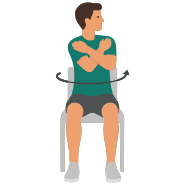
Upper back
Seated twist
Sit tall, put your right hand on your left knee, and turn your chest to the left. Hold 20 seconds, then swap sides.
20 secondsYou push back from the desk after hours in the chair and your hips feel rusty, your lower back is tight, and your neck is stuck at screen angle. A few stretches after sitting can loosen all of that in a couple of minutes. This guide gives you the exact moves, both at your desk and standing up.
You do not need 45 minutes on a mat or any equipment. What your body is asking for after a long sit is simpler than that: a change of shape, a bit of blood flow, and a few positions it has not been in since the morning.
Below you will find why the stiffness happens in the first place, a seated set you can do without leaving your chair, a standing set for the end of the day, and a realistic answer to how often you should actually get up.
When you sit, your hips stay bent, your knees stay bent, and your back holds roughly one shape for a long time. The muscles at the front of your hips are kept short. The ones along your back are kept long and quiet. None of them are doing much, so blood flow through them slows down.
After an hour or 2 of that, your body registers the stillness. That is the heavy, rusty feeling when you finally stand up. It is not damage. It is your body telling you it has been in one position too long.
Stretching after sitting works because it is the opposite input. You take joints through the range they have been missing, muscles get a signal to let go, and movement gets fluid and blood going again. That is why the first big reach after standing up feels so good: your body was already asking for it.
The stiffness comes from stillness, not from sitting in a bad shape. Your best sitting position is your next one.
This set takes about 2 minutes and you do not have to leave the chair. Move gently into each position, stop at mild tension, and keep breathing. Nothing here should hurt.
Upper back
Sit tall, put your right hand on your left knee, and turn your chest to the left. Hold 20 seconds, then swap sides.
20 secondsLet your right ear drop toward your right shoulder without lifting the shoulder. Hold 15 to 20 seconds each side.
15 to 20 seconds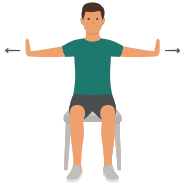
Chest
Clasp your hands behind your back or behind your head, open your elbows wide, and lift your chest. Hold 20 seconds.
20 secondsRest your right ankle on your left knee and lean your chest forward until you feel it in the back of the hip. Hold 20 to 30 seconds each side.
20 to 30 secondsReach both arms overhead, then lean a little to one side, then the other. About 15 seconds per side.
15 secondsIf you only have 30 seconds between calls, do the twist and the reach. Something small and often beats something long and rare.
At the end of a full day in the chair, stand up and give your body the positions it has not seen since breakfast: hips open, spine long, chest wide. This standing set takes about 3 minutes.
Lower back
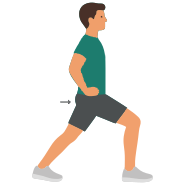
Step your right foot back into a long stance, keep your torso upright, and tuck your tailbone slightly until you feel the front of the right hip. Hold 20 to 30 seconds each side. This is the one that undoes the hours of bent hips.
20 to 30 secondsBend your knees generously and let your upper body hang toward the floor. Let your head and arms be heavy. Hold 20 to 30 seconds, then roll up slowly.
20 to 30 secondsHands on your hips, lean back a little, just until you feel your front open up. Hold a few seconds, repeat 3 times.
3 times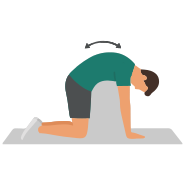
The drawing shows the basic version of the move.
Upper back
Hands on the desk, arms straight. Round your back toward the ceiling, then let it dip while lifting your chest. 8 slow rounds.
Hands on the wall, 1 leg back with the heel down. Hold 20 seconds each side.
20 secondsStop at mild tension, never at pain. A stretch that makes you wince is past the point where it does anything useful for you.
Holding a stretch is only half of it. Moving through a range of motion, with the muscles actually working, wakes your body up in a way a held stretch does not. If you feel more stiff than tight, start here instead.
A good end-of-day pattern: 1 minute of these moves to warm up, then the standing stretches from the section above. Together it is still under 5 minutes.
If you searched for back pain from sitting stretches, here is the honest version. The ache that builds over a long day in the chair is usually about staying still, not about sitting in the wrong shape. Some people slouch all day and feel nothing. Others sit very upright and still ache by 5 in the afternoon.
So the goal is not to find the 1 perfect position. It is to move regularly and give your back a variety of shapes across the day. The stretches and exercises above are exactly that, and gentle movement of this kind tends to ease the discomfort that stillness builds up.
A few ground rules when your back is already grumbling: keep every move in the comfortable range, slow everything down, and favour the moves that feel good over the ones that feel like a test. 5 minutes of gentle exercises a day, done most days, does more than 1 heroic session on the weekend.
You cannot stretch your way out of every ache, and that is fine. If nothing changes after a few weeks of regular movement, check the note at the end of this guide.
There is no magic interval, but a useful rhythm is this: break up the sitting every 45 minutes or so, even if it is just standing up, reaching overhead, and walking a few steps. 1 minute is enough for these micro breaks.
Then, once a day, do a fuller set: the desk stretches, the standing stretches, or the exercise circuit. Attach it to something that already happens, like the end of your last meeting or putting the kettle on, so it does not depend on memory or motivation.
The micro breaks keep the stiffness from piling up during the day. The daily set deals with whatever piled up anyway. You need both, and neither takes long.
When this is not for you and it is time to see a healthcare professional. This guide is for the everyday stiffness and ache that builds after long hours of sitting. It is not for you right now if your pain keeps you from sleeping, runs down a leg or an arm, comes with tingling or loss of strength, started after a blow or a fall, or has gone on for weeks without any change despite moving regularly. Those are signs to see a healthcare professional before stretching anything.
You do not need all 15 moves from this page. You need a small set you will actually do.
Give it a couple of weeks before you judge it. The first stretch feels good immediately, but the real change is how you feel at the end of a sitting day once moving often has become normal.
BackPain gives you 5 minutes of gentle exercises a day, chosen by where it bothers you and what you are after. At home, no equipment, guided one at a time. If there are exercises you like more, build your own routines with them: the best exercise is the one you will actually do.


7-day free trial · Cancel anytime
Sitting keeps your hips bent and your back in roughly 1 shape for a long time, so muscles stiffen and blood flow through them slows. Stretching is the opposite input: it takes joints through the range they have been missing and gets things moving again. That is why the first big reach after standing up feels so good.
A useful rhythm is a 1 minute movement break every 45 minutes or so, plus 1 fuller set of about 5 minutes once a day. The short breaks keep stiffness from piling up, and the daily set deals with whatever built up anyway.
Gentle, regular movement is usually what eases the ache that builds during a long day in the chair. Keep every stretch in the mild-tension range and never push into pain. If the pain runs down a leg, comes with tingling or loss of strength, or does not change after weeks, see a healthcare professional instead.
The evidence does not point at any single sitting shape as the villain. Some people slouch with no pain and others sit very upright and still ache. What seems to matter is not holding any 1 position too long, so change shape often and get up regularly.
Around 20 to 30 seconds per position is plenty, breathing normally the whole time. Go to the point of mild tension and stop there. Doing the set gently every day beats holding anything longer or harder.
BackPain is a wellness app, not a medical device. This guide is general information and is no substitute for a healthcare professional. It does not diagnose, treat, cure or prevent any condition. If your pain persists, see a healthcare professional.