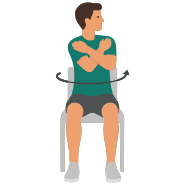
Upper back
Seated twist
: sit tall, put a hand on the opposite knee and rotate gently. Hold 20 seconds each side.
20 secondsIt is mid afternoon, your lower back is nagging, and you catch yourself slumped over the keyboard again. You sit up tall, hold it for a minute, and slide right back down. If "sit up straight" actually worked, you would not be searching how to sit with good posture.
This guide gives you a chair setup you can do in under a minute, a version for the desk and a version for the couch, and the part almost every posture article skips: what to do with your body between sittings.
It is also honest about what sitting posture can and cannot do for your back, because the 2 things are not the same.
Good posture is not a single rigid position you hold for 8 hours. It is a comfortable starting point that your body can stay in without effort, and that you leave often.
Here is the honest part. People search for bad sitting posture causes expecting slouching to be the villain, but the evidence does not back that up. Some people slouch all day and feel nothing. Some people sit very upright and hurt anyway.
What does build discomfort is staying in 1 shape for hours, whatever that shape is. Muscles that do not move get stiff, and stiff muscles complain. So the goal is not a perfect position. It is a relaxed position plus regular movement.
Your best sitting posture is your next one. Changing position often beats holding any single position perfectly.
Do this once, slowly, with the chair you use most. After that it takes 10 seconds.
The test is simple. If holding this position takes effort, something in the setup is off. Good sitting posture should feel like the easiest option in the room, not like a plank.
The chair steps above cover most of it. The extra piece at work is the screen. A laptop flat on the desk forces your head down for hours, so raise it on a stand or a stack of books and add a separate keyboard if you can.
If you cannot change the equipment, change the dose. Shorter stretches of laptop work, broken up with standing, beat a perfect setup you never leave.
The couch is built for lounging, not for typing, and that is fine. Do not fight it. For watching TV, a cushion behind your lower back makes leaning back more comfortable. For working from the couch, put the laptop on a table instead of your lap when you can, and swap positions every time you notice yourself sinking.
There is no banned position. Crossed legs, feet tucked under you, deep couch slouch, all of it is fine in short doses. The problem is any position held too long.
You could sit in a flawless position for 3 hours straight and still stand up stiff. Your back likes movement more than it likes any posture, so the real habit to build is interrupting the sitting.
Aim to get out of the chair roughly every 45 minutes. It does not need to be a break. 20 seconds of standing already counts.
None of these need willpower once they are attached to things you already do. That is the point.
If you were looking for a sitting posture workout, here it is. These are gentle moves that ease the stiffness sitting builds up, and you can do all of them without leaving the chair. The whole round takes about 5 minutes.
Upper back
: sit tall, put a hand on the opposite knee and rotate gently. Hold 20 seconds each side.
20 seconds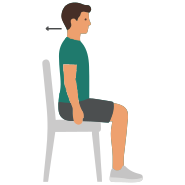
Neck
: slide your chin straight back, as if making a double chin, then release. 5 slow reps.
: roll both shoulders up, back and down. 10 slow circles.
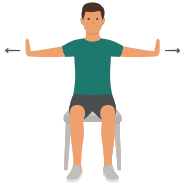
Chest
: hands behind your head, elbows wide, look slightly up and breathe. Hold 20 seconds.
20 seconds: let your chest drop toward your thighs, arms hanging. Hold 20 seconds and roll back up slowly.
20 seconds: stand up, reach both arms overhead and stretch tall for a breath or 2.
Nothing here should hurt. Gentle means gentle. If a move feels sharp, make it smaller or skip it.
When this is not for you and it is time to see a healthcare professional. This guide is for everyday stiffness from sitting. It is not for you right now if the pain keeps you from sleeping, runs down a leg or an arm, comes with tingling or loss of strength, started after a blow or a fall, or has gone on for weeks without any change. Those signs are a reason to see a healthcare professional, not to adjust your chair.
Do not try to hold a perfect position starting tomorrow. That plan fails by lunch. Do these 3 things instead.
Posture is the setup. Movement is what eases the discomfort. You need less of the first and more of the second than the internet told you.
BackPain gives you 5 minutes of gentle exercises a day, chosen by where it bothers you and what you are after. At home, no equipment, guided one at a time. If there are exercises you like more, build your own routines with them: the best exercise is the one you will actually do.


7-day free trial · Cancel anytime
Slide your hips all the way back in the chair, put your feet flat on the floor, keep your knees level with your hips and let the backrest take some of your weight. Then forget perfection and change position often. A relaxed posture you leave regularly beats a rigid one you force.
The evidence does not support slouching as the cause. Some people slouch with no pain, and some sit very upright and hurt. What builds discomfort is staying in 1 position for hours without moving. Regular movement is what makes the difference, not a perfect shape.
Hips back against the backrest, feet flat, elbows close to your body with forearms level with the desk, and the screen raised to eye height. If you work on a laptop, lift it on a stand and add a separate keyboard. Then stand up roughly every 45 minutes.
Yes, as a way to ease the stiffness that builds during long sitting. Gentle moves like seated twists, shoulder rolls and chin glides take about 5 minutes and need no equipment. They work best as a daily habit, not as a one-off when your back is already complaining.
Roughly every 45 minutes is a good rhythm to aim for. The break can be tiny, 20 seconds of standing or a walk to refill a glass of water already counts. Attaching it to things you do anyway, like calls, works better than relying on willpower.
Not in short doses. No single sitting position is banned, including crossed legs or feet tucked under you. The issue is holding any 1 position for a long time, so cross them, uncross them, and keep changing.
BackPain is a wellness app, not a medical device. This guide is general information and is no substitute for a healthcare professional. It does not diagnose, treat, cure or prevent any condition. If your pain persists, see a healthcare professional.